





Prettify error messages and stacks.
Features
- 🖍️ Pretty colors, icons and header
- 💣 Error class-specific and custom handling
- ⛑️ Normalize invalid errors
- 🔕 Log verbosity: stack, nested errors, properties
- 💥 Exception-safe
Screenshot
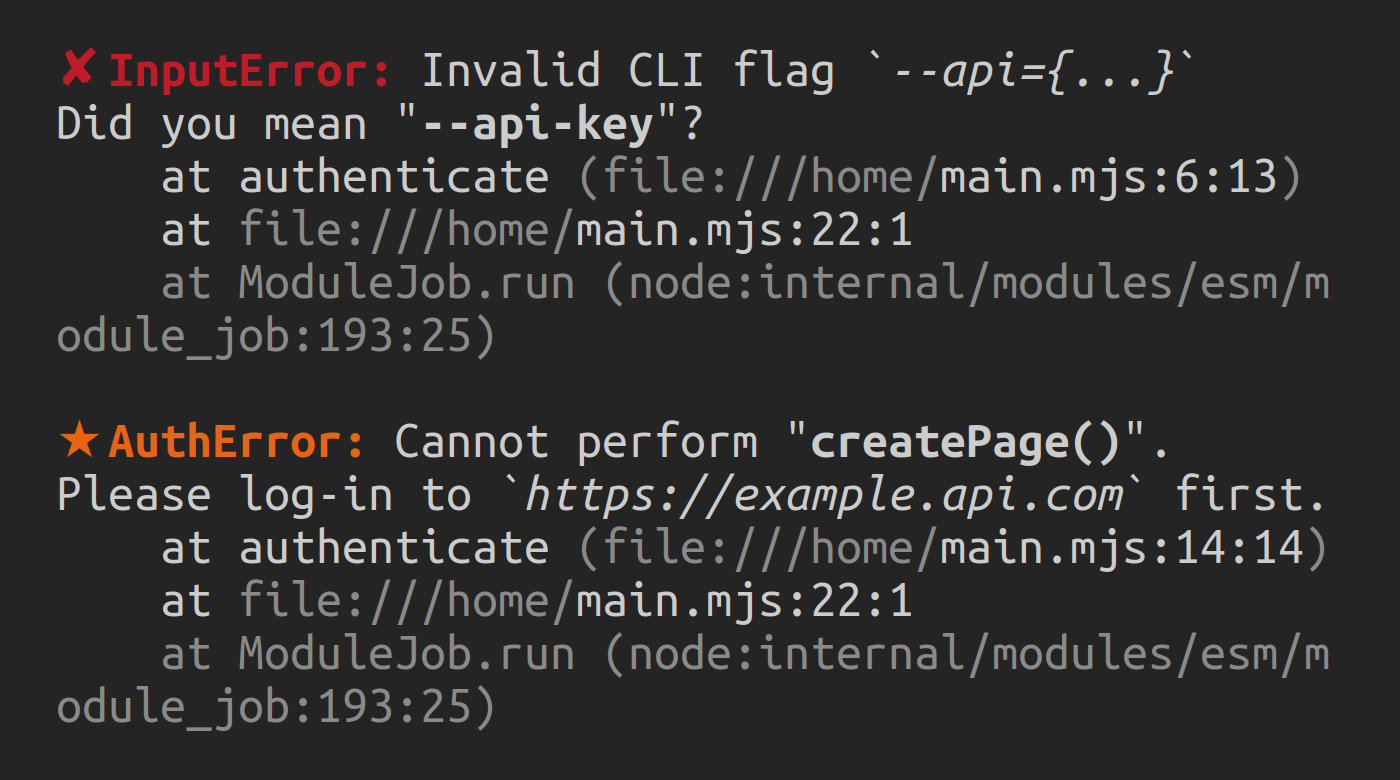
Example
General
import beautifulError from 'beautiful-error'

try {
  // ...
} catch (error) {
  const message = beautifulError(error)
  console.error(message)
}Error class-specific
const message = beautifulError(error, {
  InputError: { icon: 'warning', stack: false },
  DatabaseError: { icon: 'info', stack: false },
  default: { icon: 'cross' },
})Install
npm install beautiful-errorThis package works in Node.js >=18.18.0.
This is an ES module. It must be loaded using
an import or import() statement,
not require(). If TypeScript is used, it must be configured to
output ES modules,
not CommonJS.
API
beautifulError(error, options?)
error any
options Options?
Return value: string
Returns error as a prettified string.
This never throws. Invalid errors are silently normalized.
Options
📕 stack
Type: boolean
Default: true
Whether to show the error's stack trace.
cause
Type: boolean
Default: true
Whether to show nested errors, i.e.
error.cause
and
error.errors.
📢 props
Type: boolean
Default: true
Whether to show the error's additional properties.
🖍️ colors
Type: boolean
Default: true in terminals, false otherwise
Whether to colorize the error's message, stack trace and additional properties.
Quoted strings in the error's message are printed in bold (for "..." and
'...') and in italic (for `...`).
❌ icon
Type: string
Default: 'cross'
Icon prepended to the error's name. The available values are listed here. Can be disabled by passing an empty string.
💄 header
Type: string
Default: 'red bold'
Color/style of the error's icon and name. The available values are listed here. Several styles can be specified by using spaces. Can be disabled by passing an empty string.
💣 classes
Type: object
Default: {}
Specify different options per error class. The object:
- Keys are either the
error.name, or"default"(used if noerror.namematches) - Values are options objects
🪛 custom
Type: string | symbol
Default: beautiful
Name of a method to map the output. That method must take the output as a string argument, transform it then return it.
class ExampleError extends Error {
  beautiful(output) {
    return output.replaceAll('secret', '***')
  }
}

const error = new ExampleError('Unknown value: secret')
const message = beautifulError(error) // 'Unknown value: ***'Related projects
modern-errors: Handle errors in a simple, stable, consistent waymodern-errors-beautiful: Prettify errors messages and stacksmodern-errors-cli: Handle errors in CLI moduleserror-custom-class: Create one error class- : Utilities to properly create error classes
Credits
The logo background was created by dgim-studio.
Support
For any question, don't hesitate to submit an issue on GitHub.
Everyone is welcome regardless of personal background. We enforce a Code of conduct in order to promote a positive and inclusive environment.
Contributing
This project was made with ❤️. The simplest way to give back is by starring and sharing it online.
If the documentation is unclear or has a typo, please click on the page's Edit
button (pencil icon) and suggest a correction.
If you would like to help us fix a bug or add a new feature, please check our guidelines. Pull requests are welcome!