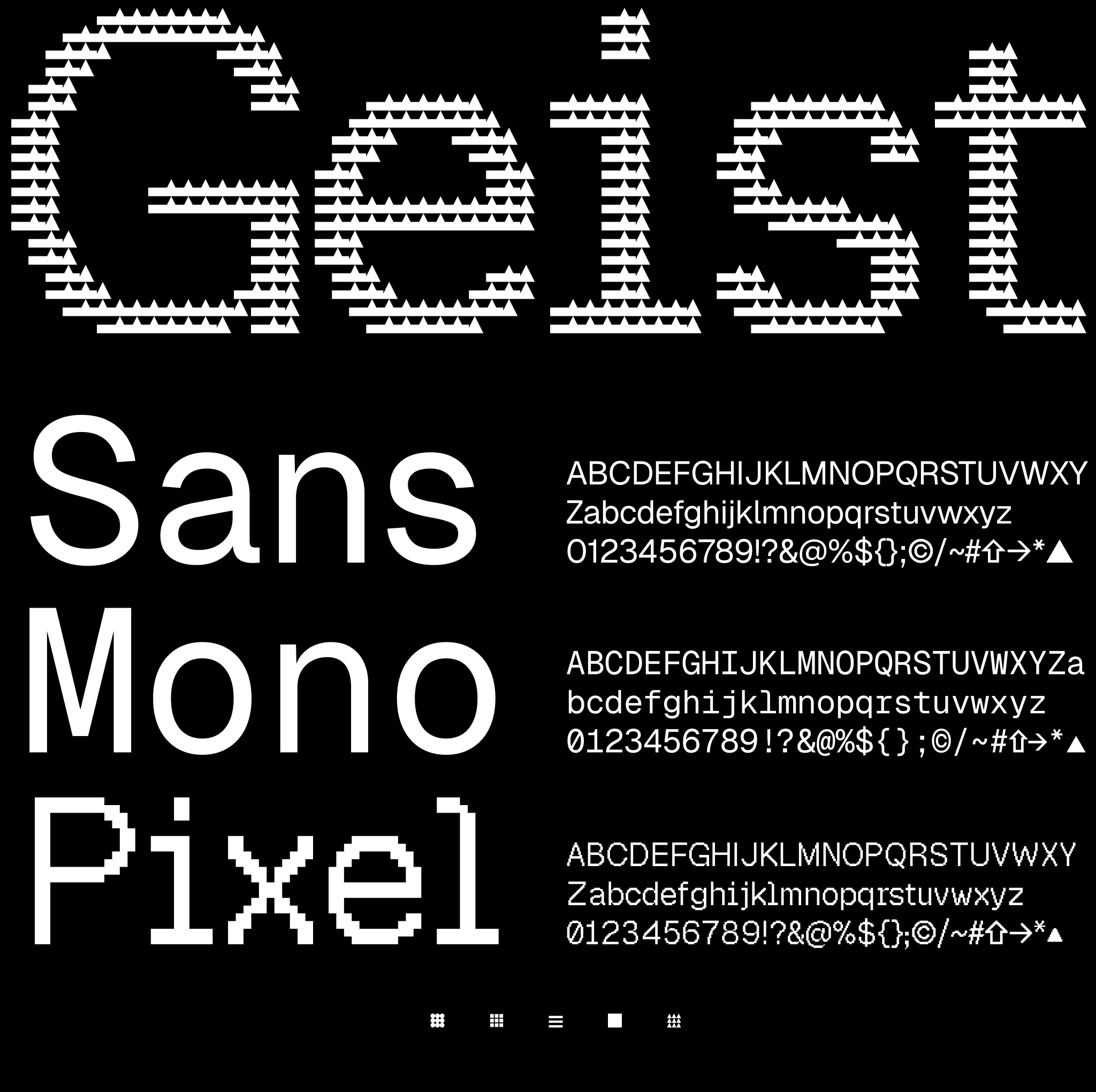
Geist Sans, Geist Mono, Geist Pixel & Geist Serif
Geist is a font family created by Vercel. Geist Sans and Geist Mono were created in collaboration with Basement Studio. Geist Pixel was created in collaboration with Andrés Briganti. Geist Serif was created in collaboration with Andrés Briganti and Mark Davis.
Geist Sans is a sans-serif typeface designed for legibility and simplicity. It is modern, geometric, and based on the principles of classic Swiss typography. It is designed to be used in body copy, headlines, logos, posters, and other large display sizes.
Geist Mono is a monospaced typeface, crafted to be the perfect partner to Geist Sans. It is designed to be used in code editors, diagrams, terminals, and other text-based interfaces where code is rendered.
Geist Pixel is a display typeface family featuring five unique pixel-based variants, each with a distinct visual style. It is designed for decorative use in headlines, logos, and other display contexts where a pixelated aesthetic is desired.
Geist Serif is a high-contrast display serif with fine, saw-toothed serifs and sharp hairlines. Its Regular and Square variants are suited to primary typography, while Triangle and Heart offer more decorative alternatives.
Installation
npm install geistUsing with Next.js
GeistSans is exported from geist/font/sans and GeistMono from geist/font/mono. Geist Pixel and Geist Serif each ship a variable entry point (geist/font/pixel/variable, geist/font/serif/variable) and one entry point per variant (e.g. geist/font/pixel/grid, geist/font/serif/square), so you only emit and preload the files you import. All are NextFontWithVariable instances. You can learn more by reading the next/font docs.
Geist Serif Variants
Use GeistSerif to load one variable font and select its shape through ELSH:
import { GeistSerif } from "geist/font/serif/variable";| Shape | ELSH value |
|---|---|
| Regular | 0 |
| Square | 25 |
| Triangle | 50 |
| Heart | 100 |
Geist Serif includes four distinct variants: Regular with round dots (the default), Square, Triangle (a nod to the Vercel logo), and Heart. Use their individual entry points to emit and preload only the fonts you import:
| Export | Entry point | CSS Variable |
|---|---|---|
GeistSerifRegular | geist/font/serif/regular | --font-geist-serif-regular |
GeistSerifSquare | geist/font/serif/square | --font-geist-serif-square |
GeistSerifTriangle | geist/font/serif/triangle | --font-geist-serif-triangle |
GeistSerifHeart | geist/font/serif/heart | --font-geist-serif-heart |
import { GeistSerifRegular } from "geist/font/serif/regular";
import { GeistSerifSquare } from "geist/font/serif/square";
import { GeistSerifTriangle } from "geist/font/serif/triangle";
import { GeistSerifHeart } from "geist/font/serif/heart";If you need the variable font and all four static variants, the aggregate entry point is available for convenience:
import {
  GeistSerif,
  GeistSerifRegular,
  GeistSerifSquare,
  GeistSerifTriangle,
  GeistSerifHeart,
} from "geist/font/serif";The aggregate entry point includes all five font files. Prefer /variable or an individual static entry point when you only need one.
Geist Pixel Variants
Use GeistPixel to load one variable font and select its shape through ELSH:
import { GeistPixel } from "geist/font/pixel/variable";| Shape | ELSH value |
|---|---|
| Regular | 0 |
| Square | 1 |
| Circle | 20 |
| Grid | 40 |
| Triangle | 60 |
| Line | 80 |
Geist Pixel includes five distinct variants. Use their individual entry points to emit and preload only the fonts you import:
| Export | Entry point | CSS Variable |
|---|---|---|
GeistPixelSquare | geist/font/pixel/square | --font-geist-pixel-square |
GeistPixelGrid | geist/font/pixel/grid | --font-geist-pixel-grid |
GeistPixelCircle | geist/font/pixel/circle | --font-geist-pixel-circle |
GeistPixelTriangle | geist/font/pixel/triangle | --font-geist-pixel-triangle |
GeistPixelLine | geist/font/pixel/line | --font-geist-pixel-line |
import { GeistPixelSquare } from "geist/font/pixel/square";
import { GeistPixelGrid } from "geist/font/pixel/grid";
import { GeistPixelCircle } from "geist/font/pixel/circle";
import { GeistPixelTriangle } from "geist/font/pixel/triangle";
import { GeistPixelLine } from "geist/font/pixel/line";The aggregate geist/font/pixel entry point remains available for backwards compatibility, but it includes all five static font files. The variable font stays isolated at geist/font/pixel/variable.
App Router
In app/layout.js:
import { GeistSans } from "geist/font/sans";

export default function RootLayout({ children }) {
  return (
    <html lang="en" className={GeistSans.className}>
      <body>{children}</body>
    </html>
  );
}Pages Router
In pages/_app.js:
import { GeistSans } from "geist/font/sans";

export default function MyApp({ Component, pageProps }) {
  return (
    <main className={GeistSans.className}>
      <Component {...pageProps} />
    </main>
  );
}If you're using a version of Next.js that's older than 15, then in next.config.js or next.config.mjs add:
/** @type {import('next').NextConfig} */
const nextConfig = {
  reactStrictMode: true,
+  transpilePackages: ["geist"],
};

export default nextConfig;This is required to fix errors like:
TypeError: next_font_local__WEBPACK_IMPORTED_MODULE_0___default(...) is not a functionSyntaxError: Cannot use import statement outside a module
With Tailwind CSS
All Geist fonts can be used through CSS variables.
GeistSans:--font-geist-sansGeistMono:--font-geist-monoGeistPixel:--font-geist-pixelGeistPixelSquare:--font-geist-pixel-squareGeistPixelGrid:--font-geist-pixel-gridGeistPixelCircle:--font-geist-pixel-circleGeistPixelTriangle:--font-geist-pixel-triangleGeistPixelLine:--font-geist-pixel-lineGeistSerif:--font-geist-serifGeistSerifRegular:--font-geist-serif-regularGeistSerifSquare:--font-geist-serif-squareGeistSerifTriangle:--font-geist-serif-triangleGeistSerifHeart:--font-geist-serif-heart
In app/layout.js:
import { GeistSans } from "geist/font/sans";
import { GeistMono } from "geist/font/mono";
import { GeistPixelSquare } from "geist/font/pixel/square";
import { GeistSerif } from "geist/font/serif/variable";

export default function RootLayout({ children }) {
  return (
    <html
      lang="en"
      className={`${GeistSans.variable} ${GeistMono.variable} ${GeistPixelSquare.variable} ${GeistSerif.variable}`}
    >
      <body>{children}</
Tailwind CSS V4
Then in tailwind.css:
@theme {
  /* rest of your theme config */

  --font-sans: var(--font-geist-sans);
  --font-mono: var(--font-geist-mono);
  --font-serif: var(--font-geist-serif);
  --font-pixel-square: var(--font-geist-pixel-square);
  --font-pixel-grid: var(--font-geist-pixel-grid);
  --font-pixel-circle: var(--font-geist-pixel-circle);
  --font-pixel-triangle: var(--font-geist-pixel-triangle);
  --font-pixel-line: var(--font-geist-pixel-line
Tailwind CSS V3
Then in tailwind.config.js:
module.exports = {
  theme: {
    extend: {
      fontFamily: {
        sans: ["var(--font-geist-sans)"],
        mono: ["var(--font-geist-mono)"],
        serif: ["var(--font-geist-serif)"],
        "pixel-square": ["var(--font-geist-pixel-square)"],
        "pixel-grid": ["var(--font-geist-pixel-grid)"],
        "pixel-circle": ["var(--font-geist-pixel-circle)"],
        "pixel-triangle": ["var(--font-geist-pixel-triangle)"],
        "pixel-line": ["var(--font-geist-pixel-line)"],
      },
    },
  },
};License
The Geist font family is free and open sourced under the SIL Open Font License.
Inspiration
Geist has been influenced and inspired by the following typefaces: Inter, Univers, SF Mono, SF Pro, Suisse International, , and . We thank the creators of these typefaces for their craft.