A zero configuration, zero dependency test runner for ECMAScript Modules—made specifically for getting started quick. Painless migration to the bigger guns if you end up needing them.
Features
Native ECMAScript Modules support.
Simple: No configuration. No test timeouts. No global scope pollution. No runner hooks. No compilation step. No source maps.
Super fast: Asynchronous tests run concurrently, individual modules run concurrently using multiple CPUs, no overhead from compilation.
Usage
Test Syntax
import test from 'oletus'// this should look pretty familiartest('arrays are equal', t => {
bearror
mail@natan.codes
t.
deepEqual
([
1
,
2
], [
1
,
2
])
})
// you can use async functions or otherwise return Promises
By default, Oletus runs all files that exist in your /test directory.
Alternatively, you can specify a list of files to run. Note that the glob
pattern in the example below is handled by your shell, not by Oletus.
{ "test": "oletus test.js src/**/*.test.js"}
Reporters
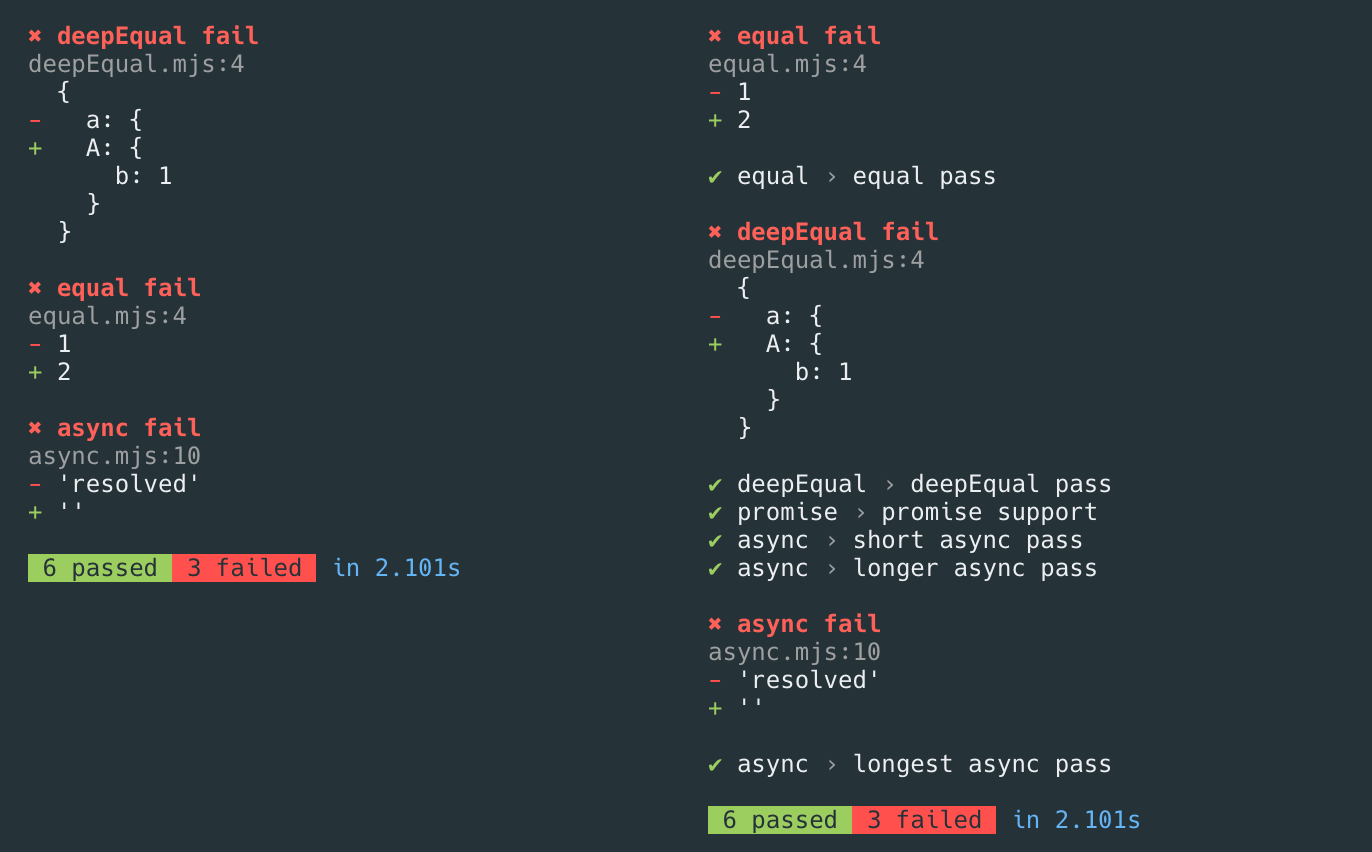
Oletus has a concise reporter on local runs and a verbose reporter on CI environments.
API
test :: (String, StrictAssertModule -> Promise?) -> Promise TestResult
The test function, which is the default export from Oletus, takes the following arguments:
title: A String describing the test case.
implementation: A function that runs your assertions. The implementation has a single parameter (t, for example) that gets passed the strict node assertion module. If this function returns a Promise, Oletus awaits the result to know if your test
passes. Otherwise the test is assumed to pass if it doesn't throw.
The return value from test function is a Promise of an object with the following shape { didPass, title, location, message }. Note that for most cases, you don't actually need to do anything with the returned Promise, but for reference, this is what its resolution value looks like:
didPass: A boolean to indicate whether the test has passed.
title: The title of the test.
location: The stack trace for the failure reason, or an empty string if didPass was true.
message The failure reason, or an empty string if didPass was true.
Examples
Code coverage
Oletus works great together with c8. C8 is a tool for running code coverage natively using the V8 built-in code coverage functionality. The reason this pairs well with Oletus is because with Oletus, you tend to run your ESM code natively, and no other coverage tools can deal with that. Set it up like this:
{ "test": "c8 oletus test.js src/**/*.test.js"}
Using Oletus for testing CommonJS modules
Your codebase doesn't need to be written as EcmaScript 6 modules to use Oletus. The only part of your code that really needs to contain es6 modules is your tests themselves. But you're free to import CommonJS modules via CommonJS Interoperability:
import test from 'oletus'import myCJSModule from '../src/index.js'test ('my export', t => { t.equals (myCJSModule.myExportedAnswer, 42)})
Running tests in sequence instead of parallely
Because the test function returns a Promise, all you need to do is add await
statements in front of your tests to run them in sequence. Note that your
runtime needs to support top-level-await. Otherwise you can wrap your tests in
an async function and call it at the end of your file.
await test('foo', async t => { const foo = Promise.resolve('foo') t.equal(await foo, 'foo')})await test('bar', async t => { const bar = Promise.resolve('bar') t.equal(await bar, 'bar')})
Completely custom test run order
Because the test function returns a Promise, you can manipulate the run order
of your tests in any way you see fit. For example, you could execute your tests
in batches of 2 by awaiting Promise.all calls.