Understudy
A means to provide interceptors (i.e. hooks) when performing asynchronous actions.
- All hooks are asynchronous
-
- All logic done by
perform-based actions is asynchronous.
- All logic done by
-
- Error first helpers.
-
- Fail fast.
- Consistency in arguments provided to hooks & actions
-
- Hooks can only mutate arguments that they are passed, not the number of arguments.
-
- Use of callback arguments to pass information removes focus on return values to mitigate this potentially odd behavior.
- Opt-in behavior.
-
- Only calls to
.perform(action ...enable hooking.
- Only calls to
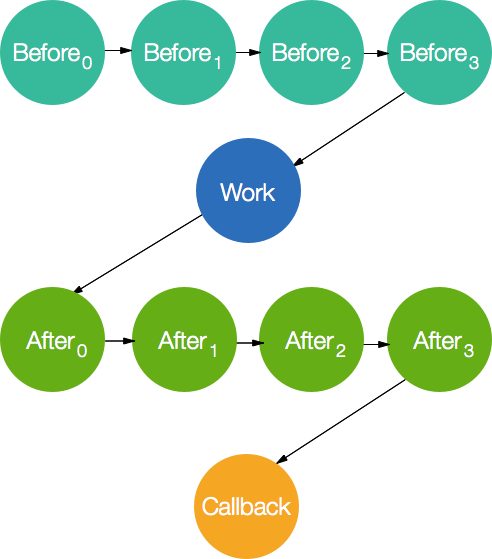
By depending on understudy you are exposed to four methods: perform, before, after and waterfall
.perform(action, arg0, /* arg1, ... */, work, callback)
This is the core API for invoking hooks provided by Understudy. Each call to perform for the same action should have a consistent argument signature because this is what will be expected by each of the before and after hooks for the action. The overall flow control is:
- Call all
beforehooks foraction. - Call
workfunction foraction. - Call all
after hooks foraction`. - Call
callbackwith results fromworkfunction.
.before(action, arg0, /* arg1, ... */, next)
Called before the work function is executed in perform with exactly the arguments passed to .perform. Nothing passed to next have an impact on the flow control above except any error is supplied short-circuits execution to the callback.
.after(action, arg0, /* arg1, ... */, next)
Called after the work function is executed in perform with exactly the
arguments passed to .perform. Nothing passed to next have an impact on the
flow control above except any error is supplied short-circuits execution to
the callback.
While the above statement is true when using .perform, after hooks acquire a
waterfall like behavior with .waterfall where the result of work function
gets passed to the after hooks. Each after hook is then able to mutate the
arguments passed to the next one. Strongly discouraged to change number of
arguments for your user's sanity.
.waterfall(action, arg0, /* arg1, ... */, work, callback)
This is a slightly different perform that is very useful for when you have to
modify state received from a function in a sequence of configurable hooks.
- Call all
beforehooks foraction. - Call
workfunction foraction. - Call all
after hooks foractionwith the result returned from thework` function. - Call
callbackwith results from theafterhooks execution (if any) and otherwise the results from theworkfunction.
Real-world Usage
Let's consider a real-world application with two interceptable actions:
start: Application has startedhttp:request: Application has received an incoming HTTP request.
We could easily implement this App behavior in Understudy:
var Understudy = require('understudy');

var App = module.exports = function App() {
  Understudy.call(this);
};

//
// Starts the application after running before and
// after hooks.
//
App.prototype.start = function (options, callback) {
  this.perform('start', options, function (next) {
    //
    // Here, `options` may have been mutated from the execution
    // of the before hooks.
    // ...
    // Do some other async thing
    // ...
    // These arguments are passed to the final callback unless
More Examples
Error handling when no callback is provided
Each before and after hook can provide an optional error to short-circuit evaluation of the flow that would normally follow it. This error will be provided to your callback, when supplied. In the event that you DO NOT provide a callback and a before, after or work function responds with an Error IT WILL BE IGNORED AND FLOW WILL CONTINUE. e.g.
var Understudy = require('understudy');
var actor = new Understudy();

actor.before('always', function (next) {
  next(new Error('I always fail'));
});

actor.after('always', function (next) {
  console.log('I always get called. NO MATTER WHAT');
  console.log('BUT, only when no callback is supplied.');
  next(new Error('Another swallowed error'));
});

actor.perform('always'
In other words (as in the above example): if you do not supply a callback to your .perform then understudy will consider all of your before, after and work functions as "fire and forget".