contents
node-x11
Pure-JavaScript X11 protocol client for Node.js — no native code, no runtime dependencies. It implements all 120 core protocol requests and 34 core events, and the Apple-WM, BIG-REQUESTS, Composite, DAMAGE, DOUBLE-BUFFER, DPMS, DRI3, Generic Event, GLX, MIT-SCREEN-SAVER, MIT-SHM, Present, RANDR, RECORD, RENDER, SHAPE, SYNC, X-Resource, XC-MISC, XFIXES, XINERAMA, XInputExtension, XKEYBOARD, XTEST and XVideo extensions — including the modern direct-rendering path (GPU frames as dma-buf pixmaps via DRI3 + Present, see docs/ext/dri3.md). The API reference is in docs/.


Documentation & live demos: https://sidorares.github.io/node-x11/ — the
playground runs ordinary
node-x11 code in your browser against a pure-JavaScript X server (lib/xserver)
that ships with this package, including OpenGL via GLX translated to WebGL
(browser/glx/).
The client also runs in browsers: DISPLAY strings accept a pluggable
protocol prefix (x11.registerDisplayProtocol(name, connect) +
myproto/host:0), and createClient({ stream }) accepts any duplex stream.
See the custom transports guide.
It runs under Bun too, including the parts that pass file descriptors over the connection (MIT-SHM segments, DRI3 buffers) — and there, uniquely, descriptors can also be received: see Running under Bun.
Install
npm install x11Requires Node.js 18 or later, or Bun.
Windows: run an X server such as VcXsrv,
Xming or Cygwin/X.
On Windows the client always connects over TCP (port 6000 + display number, to
display :0 on localhost when DISPLAY is unset), so the server has to
accept TCP connections. Inside WSL, node-x11 is an ordinary Linux client.
Example
Core requests usage:
const x11 = require('x11');

const { Exposure, PointerMotion } = x11.eventMask;

x11.createClient((err, display) => {
  if (err) {
    console.log(err);
    return;
  }
  const X = display.client;
  const root = display.screen[0].root;
  const wid = X.AllocID();
  X.CreateWindow(
    wid,
    root, // new window id, parent
    0,
    0,
    500,
Screenshots
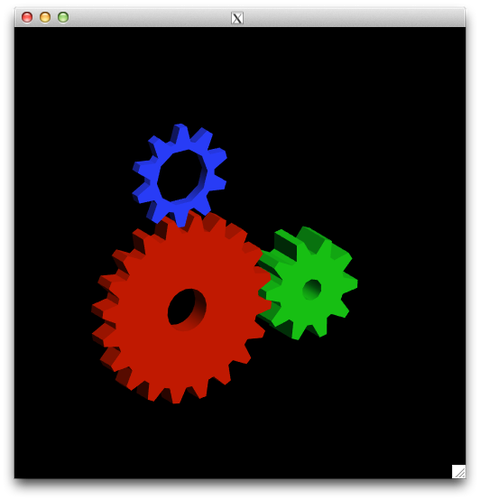

examples/opengl/glxgears.js and
examples/opengl/teapot.js over indirect GLX.
More, running in your browser: the live demos.
In use
- ntk - higher level toolkit on top of X11
- react-x11 - React renderer with X11 as a target, built on ntk
- node-remote - media center controller (archived)
- tiles - tiling window manager
- vnc - vnc client.
X11 resources/documentation:
- Xplain - A series of articles to help explain the X Window System https://magcius.github.io/xplain/article/
- Official X11 docs
- protocol specification
- C Xlib to X11 request mapping table https://tronche.com/gui/x/xlib/appendix/a.html
Other implementations
- C: Xlib - https://www.x.org/releases/current/doc/libX11/libX11/libX11.html https://tronche.com/gui/x/xlib/
- C: XCB - https://xcb.freedesktop.org/
- Python: https://github.com/python-xlib/python-xlib ( pypi: https://pypi.org/project/python-xlib/ )
X servers in JavaScript
node-x11 ships its own: x11.createServer / lib/xserver, the server the
playground runs in your
browser. Earlier DOM-based servers: