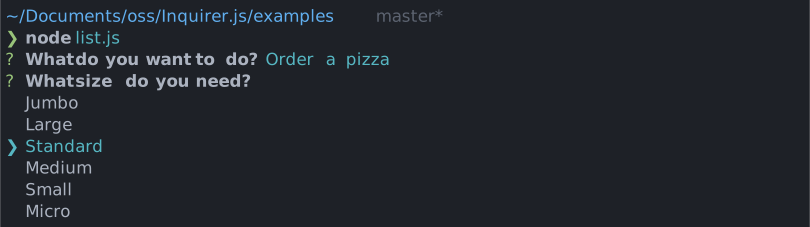
Simple interactive command line prompt to display a list of choices (single select.)
Installation
yarn
pnpm
yarn add @inquirer/prompts
pnpm add @inquirer/prompts
bun
deno
bun add @inquirer/prompts
deno add npm:@inquirer/prompts
npm
npm install @inquirer/prompts
Or
yarn
pnpm
yarn add @inquirer/select
pnpm add @inquirer/select
bun
deno
bun add @inquirer/select
deno add npm:@inquirer/select
npm
npm install @inquirer/select
On Deno, prompts detect the terminal's unicode and color support from the environment, so run your script with --allow-env.
Usage
import { select, Separator } from '@inquirer/prompts';// Or// import select, { Separator } from '@inquirer/select';const answer = await select({ message: 'Select a package manager', choices: [ { name: 'npm', value: 'npm', description: 'npm is the most popular package manager', }, { name: 'yarn', value: 'yarn', description: 'yarn is an awesome package manager', }, new Separator(), { name: 'jspm', value:
Options
Property
Type
Required
Description
message
string
yes
The question to ask
choices
Choice[]
yes
List of the available choices.
default
string
no
Defines in front of which item the cursor will initially appear. When omitted, the cursor will appear on the first selectable item.
pageSize
number
no
By default, lists of choice longer than 7 will be paginated. Use this option to control how many choices will appear on the screen at once.
loop
boolean
no
Defaults to . When set to , the cursor will be constrained to the top and bottom of the choice list without looping.
Separator objects can be used in the choices array to render non-selectable lines in the choice list. By default it'll render a line, but you can provide the text as argument (new Separator('-- Dependencies --')). This option is often used to add labels to groups within long list of options.
value: The value is what will be returned by await select().
name: This is the string displayed in the choice list.
description: Option for a longer description string that'll appear under the list when the cursor highlight a given choice.
short: Once the prompt is done (press enter), we'll use short if defined to render next to the question. By default we'll use name.
disabled: Disallow the option from being selected. If disabled is a string, it'll be used as a help tip explaining why the choice isn't available.
choices can also be an array of string, in which case the string will be used both as the value and the name.
Keybindings
Set INQUIRER_KEYBINDINGS=vim, INQUIRER_KEYBINDINGS=emacs, or INQUIRER_KEYBINDINGS=vim,emacs to enable alternative navigation keybindings globally.
When Vim keybindings are enabled, the prompt disables type-to-search so navigation keys are not interpreted as search input. You can override the environment setting per prompt with theme.keybindings.
Theming
You can theme a prompt by passing a theme object option. The theme object only need to includes the keys you wish to modify, we'll fallback on the defaults for the rest.
This function allows you to customize the keyboard shortcuts help tip displayed below the prompt. It receives an array of key-action pairs and should return a formatted string. You can also hook here to localize the labels to different languages.
It can also returns undefined to hide the help tip entirely.
theme: { style: { keysHelpTip: (keys) => { // Return undefined to hide the help tip completely. return undefined; // Or customize the formatting. Or localize the labels. return keys.map(([key, action]) => `${key}: ${action}`).join(' | '); }; }}
theme.indexMode
Controls how indices are displayed before each choice:
hidden (default): No indices are shown
number: Display a number before each choice (e.g. "1. Option A")
License
Copyright (c) 2023 Simon Boudrias (twitter: @vaxilart)
Licensed under the MIT license.