var it = iterator(node);var next;while (next = it.next(Node.TEXT_NODE)) { console.log(next.nodeValue) // next textnodes after node}
API
iterator(node, root)
Initialize an iterator starting on the node. Optionally you can
specify a root to limit your traversal to a particular subtree.
root must be either a parent or an ancestor of node.
var it = iterator(el.firstChild, el)
iterator#next([expr], [n])
Gets the next DOM node. If no node exists, return null.
You may pass an expression expr, to grab the first node that
matches expr.
Additionally, you can pass a number to select the nth node.
Defaults to 1 or the 1st node.
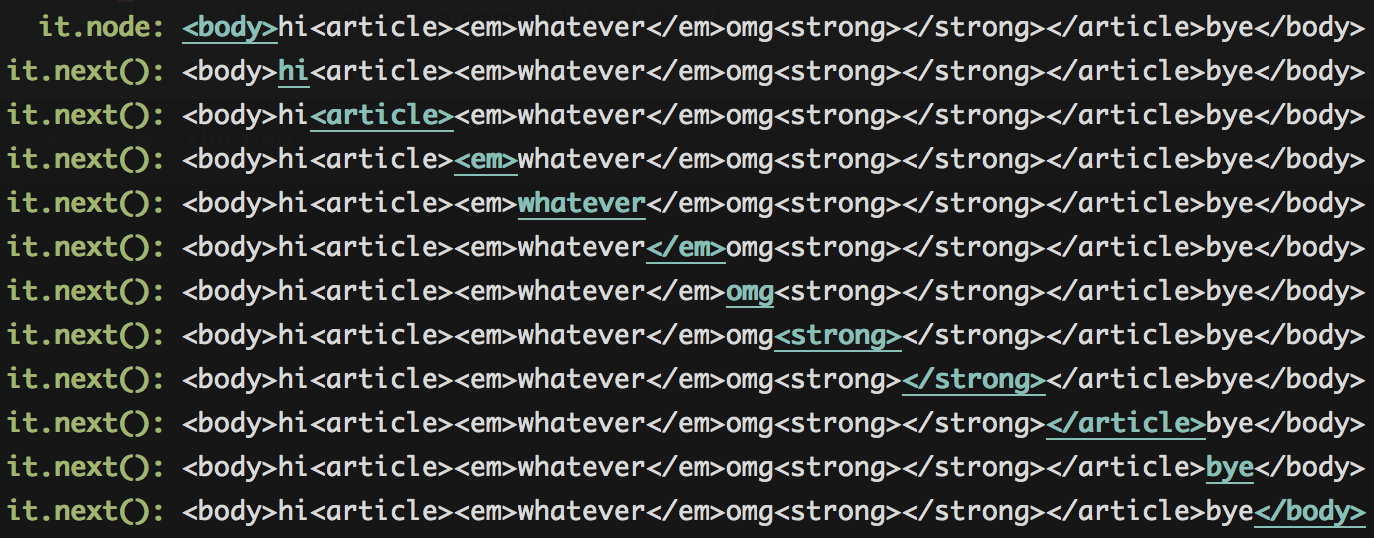
var node = it.next()// select the 2nd element node we come acrossvar next = it.next(Node.ELEMENT_NODE, 2)
Here's a look at how the DOM is traversed:
iterator#prev(), iterator#previous()
Gets the previous DOM node. If no node exists, return null.
You may pass an expression expr, to grab the first node that
matches expr.
Additionally, you can pass a number to select the nth node.
Defaults to 1 or the 1st node.
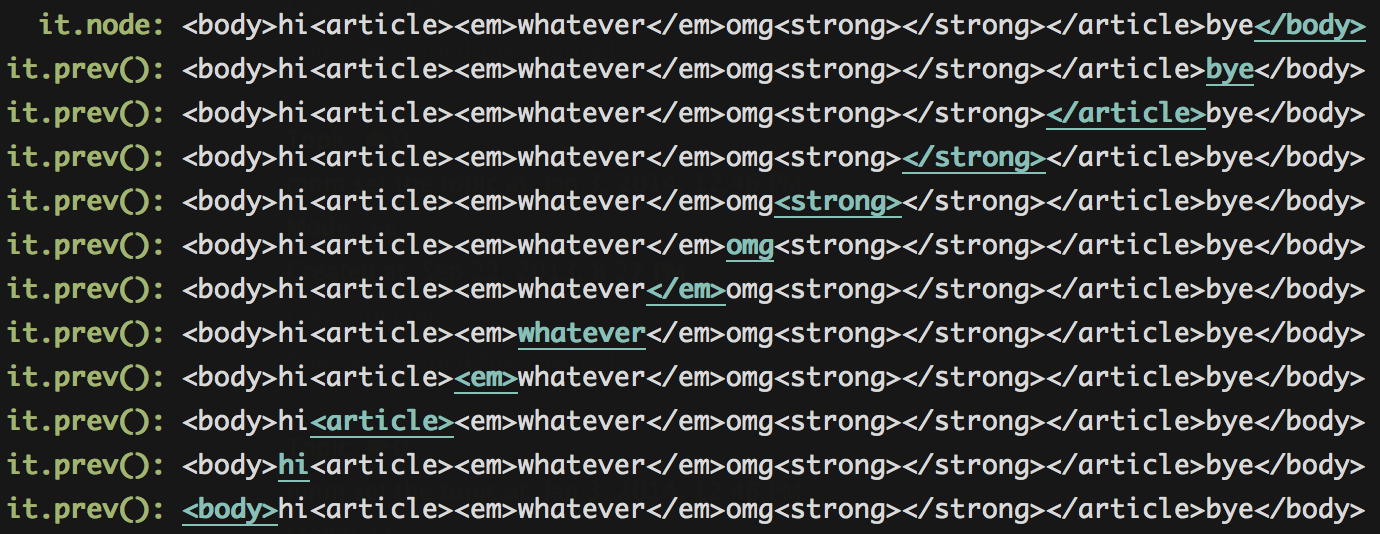
var node = it.prev()// select the 2nd element node we come acrossvar prev = it.prev(Node.ELEMENT_NODE, 2)
Here's a look at how the DOM is traversed:
iterator.select(expr)
iterate over nodes that pass the expression expr. The expr can be an
enum, number, string or function. If it's a number, the nodeType is compared.
This function can be chained where all expressions are OR-ed.
select all element nodes or comment nodes
or nodes with the nodeValue "sloth" or
nodes that pass the function fn.
iterator.reject(expr)
iterate over nodes that do not pass the expression expr. The expr can be an
enum, number, string or function. If it's a number, the nodeType is compared.
This function can be chained where all expressions are AND-ed.
reject all element nodes and comment nodes
and nodes with the nodeValue sloth and
nodes that pass the function fn".
iterator.revisit(revisit)
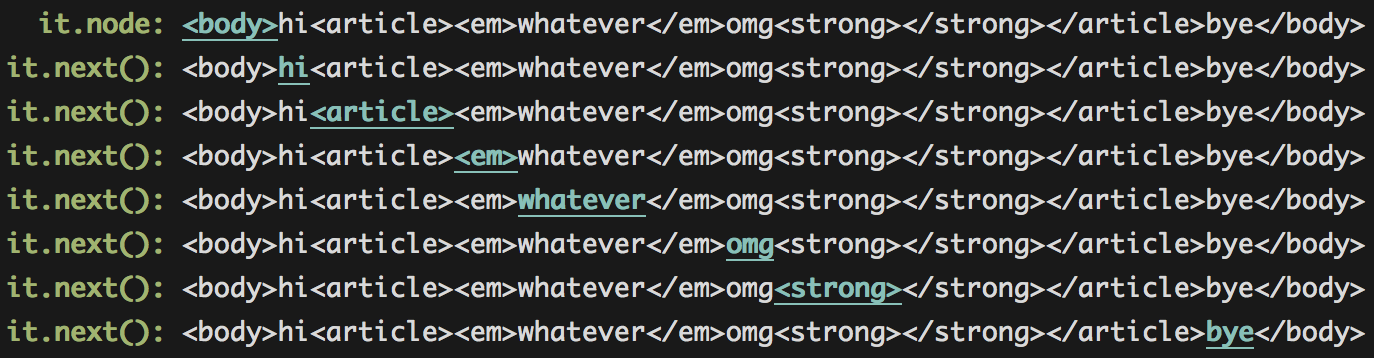
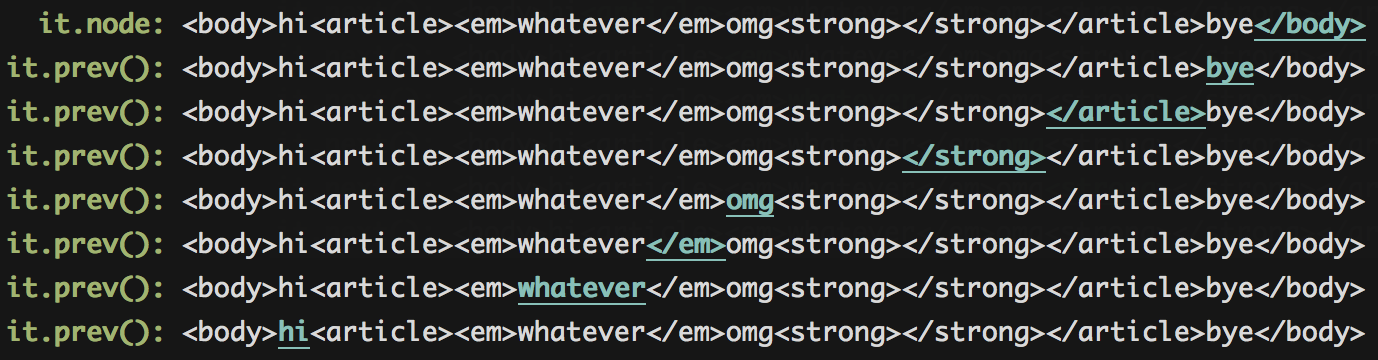
You can also skip over elements you already visited, by setting revisit to false. By default, revisit is set to true.
it.revisit(false);
Here's how that would change the iterator:
it.next():
it.prev()
iterator.opening()
Jump to the opening tag of an element. This is the default.
var dom = domify('<em>hi</em>');var it = it(dom).opening()it.next() // 'hi'
iterator.closing()
Jump to the closing tag of an element
var dom = domify('<em>hi</em>');var it = it(dom).closing()it.prev() // 'hi'
iterator.peek([expr], [n])
Sometimes you want to peek on the following or previous node without actually visiting it. With peek you can peek forward or backwards n steps. If no n is given, peek forward 1 step.