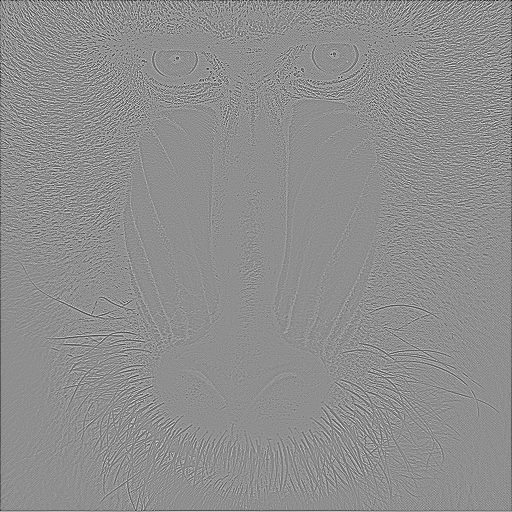
//Read in test imagevar lena = require("luminance")(require("lena"))//Generate a 5-point Laplace filtervar filter = require("ndarray-pack")([[0, 1, 0], [1, -4, 1], [0, 1, 0]])//Convolve them togetherrequire("ndarray-convolve")(lena, filter)
This produces the following array:
Install
npm install ndarray-convolve
API
var convolve = require("ndarray-convolve")
convolve( ... )
Performs a convolution between two images with zero boundary conditions. As long as it does not cause unnecessary cropping, the kernel (b) will be assumed to have its origin in the center of the kernel (for even kernels, slightly to the right of the center, for example [1,2,3,4] would be assumed to have it origin at 3). There are four ways you can call this function:
convolve(a, b)
Convolves a and b storing the result in a
convolve(out, a, b)
Convolves a and b storing the result in out
convolve(a_r, a_i, b_r, b_i)
Convolves two complex arrays storing the result in a_r, a_i
convolve(out_r, out_i, a_r, a_i, b_r, b_i)
Convolves two complex array storing the result in out_r, out_i
convolve.wrap( ... )
Convolves two arrays with periodic boundary conditions. Same convention as convolve
convolve.correlate( ... )
Cross correlates two arrays with zero boundary conditions. Same convention.
convolve.correlate.wrap( ... )
Cross correlates two arrays with wrapped boundary conditions. Same convention again.