Rozu is a webhook API server, using MongoDB for persistent storage & Redis for pub/sub of inbound events
Each response will include a Link header, and an Array of Objects with IANA defined rel properties & URIs.
Receiving webhook events
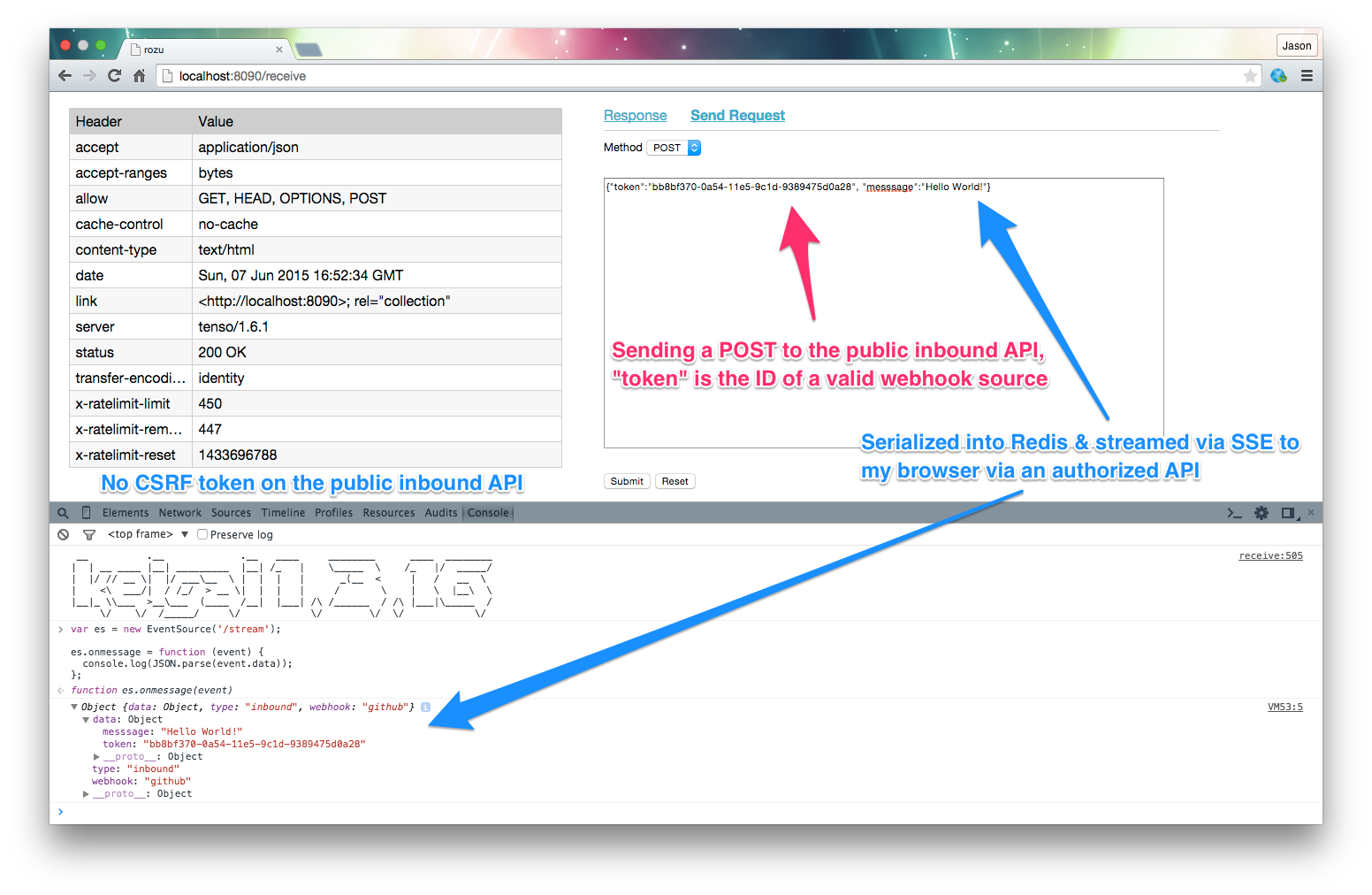
Rozu has a publically accessible route /receive which will accept a JSON or form encoded payload & put it into Redis
for pub/sub behavior in your local stack. Inbound requests must include a user supplied token (token in config.json)
which maps to a registered webhook; tokens are v1 UUIDs.
Inbound events will be published with a channel name of config.id_webhook.name, e.g. "rozu_github".
Sending webhook events
Sending a webhook is as easy as publishing into Redis with a channel name of config.id_webhook.name_send,
e.g. "rozu_github_send", or POST to /send after authenticating at /login. Outbound webhook properties to configure
the request are uri, & encoding. If not specified encoding will default to json. The value of encoding can be
json, querystring, or form. The request body will contain the webhook id as the value of config.token, for
validation.
Custom headers for outbound webhooks are supported by specifying a headers value (an Object is expected).
Sending an outbound webhook from Redis may look like this:
MongoDB (persistent storage of accounts, & webhook configurations)
Redis (pub/sub for local stack of inbound events)
(Optional) nginx for SSL termination, & reverse proxy
How do I run Rozu?
Rozu can be up and running in 3 steps! When run in a production environment, it's recommended that you use nginx
to terminate SSL, and reverse proxy to Rozu. Using a daemon like upstart (on Linux) to run rozu is ideal.